Automation
CRM for businesses in Morocco: how to choose, deploy and make it pay off in 2026
HubSpot, Pipedrive, Excel or custom CRM: a complete method to structure your leads, automate follow-up and increase conversion rates in Morocco.
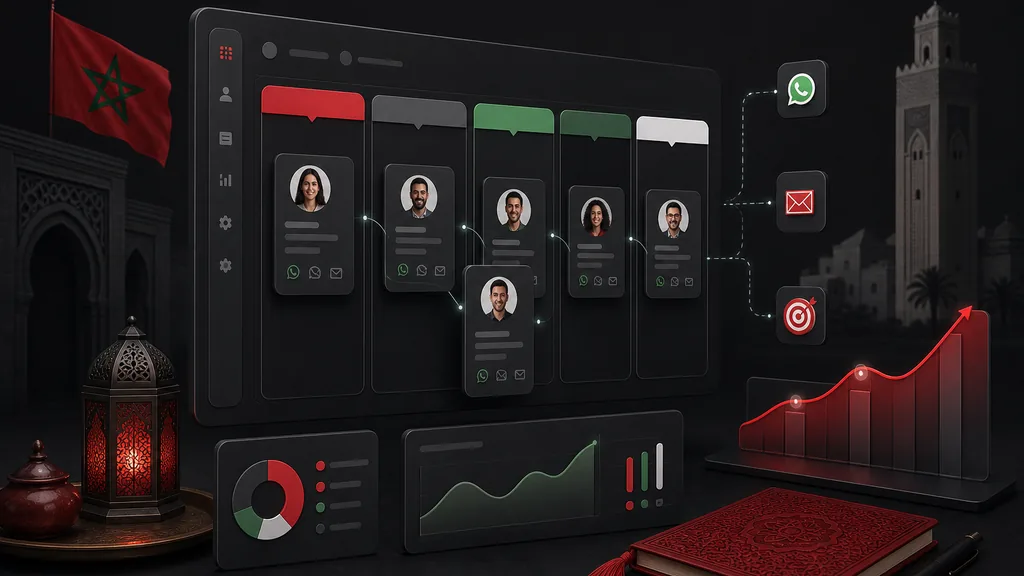
Why a CRM has become essential in Morocco
You invest in Meta Ads, Google Ads or TikTok. Leads arrive: forms, calls, WhatsApp messages. And then? If your sales team logs contacts in a shared Excel file, a notebook or scattered WhatsApp conversations, you mechanically lose part of your advertising investment. It's not a media budget problem: it's a follow-up problem.
In Morocco, where WhatsApp is the dominant communication channel between businesses and customers, a well-configured CRM is no longer a luxury reserved for large accounts. It's the infrastructure that turns your marketing spend into measurable revenue. This guide explains how to choose the right tool for your size, industry and budget — and how to get your teams to actually use it.
The problem: where your leads go
We regularly audit Moroccan businesses spending 15,000 to 50,000 MAD per month on digital advertising. The finding is consistent: leads arrive, but nobody knows exactly how many were contacted, in what timeframe, by whom, and with what result. Sales reps juggle three WhatsApp numbers, a Google Sheet and paper notes.
The consequences are quantifiable. A lead not called back within the first 5 minutes has an 80% chance of never converting. A lead called after 24 hours converts 7 times less than one contacted within an hour. Without a CRM, you don't see these leaks — you only notice that "marketing doesn't work", when the problem is downstream of acquisition.
- Leads scattered across WhatsApp, email, phone and Excel
- No visibility on time to first contact
- Impossible to measure lead-to-customer conversion rate
- History lost when a salesperson leaves
- Campaigns optimized on leads, not actual sales
What is a CRM and what should it do for you
A CRM (Customer Relationship Management) centralizes all your prospect and customer interactions: contact details, acquisition source, exchange history, sales pipeline status, follow-up tasks and associated documents. It's not a simple digital address book: it's the nervous system of your sales machine.
For a Moroccan business in 2026, an effective CRM must at minimum: automatically capture leads from your web forms, Meta Lead Ads, Google Ads and WhatsApp; assign each lead to a salesperson with instant notification; enforce a clear qualification pipeline; track every action (call, message, email, meeting); and produce actionable dashboards for management and marketing.
HubSpot, Pipedrive, Zoho or custom CRM: how to choose
The CRM market is vast. For a Moroccan SME, four tool families dominate. HubSpot offers a solid free tier and complete marketing/sales scaling — ideal if you want to unify acquisition and sales follow-up, with budgets that can reach $500-2,000/month on paid plans. Pipedrive is simpler, pipeline-visual, excellent for sales teams of 2 to 15 people, from $15/user/month.
Zoho CRM is an economical alternative popular in Morocco (from $14/user), with good value but a less intuitive interface. Finally, a custom CRM — like Mohtaoua's proprietary solution — becomes relevant when your processes are specific (regulated sector, multi-branch, ERP integration) or when you want native WhatsApp + Meta + billing integration without stacking five foreign SaaS subscriptions.
- HubSpot: comprehensive, free to start, expensive at scale, excellent for marketing + sales
- Pipedrive: simple, visual pipeline, ideal for SME sales teams
- Zoho CRM: economical, functional, steeper learning curve
- Custom CRM: specific processes, local integrations (WhatsApp API, payment gateways, ERP)
- Excel/Google Sheets: acceptable under 20 leads/month, unmanageable beyond
Building a sales pipeline that works
Most CRMs fail not because of the tool, but because of a poorly designed pipeline. A pipeline that's too complex (12 stages) will never be updated. One that's too simple (3 stages) gives no visibility on blockages. For most Moroccan businesses, 5 to 7 stages are enough.
Here's the structure we deploy most often: New lead → Contacted → Qualified → Proposal sent → Negotiation → Won / Lost. Each transition must have a clear rule: "Contacted" means a real first exchange (call or WhatsApp), not an attempt. "Qualified" means budget, need and timeline are confirmed. These definitions prevent artificial pipeline inflation.
- New lead: automatic entry from form, ad or WhatsApp
- Contacted: real first exchange within 60 minutes (target)
- Qualified: need, budget and timeline confirmed
- Proposal: quote or offer sent
- Negotiation: active exchanges on terms
- Won / Lost: mandatory closure with reason if lost
WhatsApp + CRM: the essential duo in Morocco
In Morocco, over 90% of your prospects prefer WhatsApp to email for first exchanges. A CRM disconnected from WhatsApp is therefore an incomplete CRM. Integration can take three forms: WhatsApp Business App (free, manual, acceptable for 1-2 salespeople), WhatsApp Business API via a partner like Twilio or 360dialog (automated, scalable, requires Meta validation), or an integrated solution like Mohtaoua CRM that centralizes conversations, assignment and follow-ups.
The goal: every incoming WhatsApp message creates or updates a contact record in the CRM, with full history visible to the whole team. No more "this lead is mine, it's on my phone". The salesperson gets a notification, replies from the CRM or their phone, and every interaction is tracked.
Connecting your acquisition channels to the CRM
A CRM isolated from your ad campaigns forces manual lead entry — a source of errors and delays. Priority integrations for a Moroccan business in 2026:
- Meta Lead Ads → CRM: via Zapier, Make or native HubSpot/Pipedrive integration (real-time lead)
- Google Ads (forms) → CRM: webhook or Zapier, with UTMs preserved for attribution
- Website form → CRM: native plugin or webhook from your landing page
- TikTok Lead Gen → CRM: via Make/Zapier, fast-growing in Morocco
- Incoming WhatsApp → CRM: Business API or integrated solution
- Conversion feedback → Meta/Google: send "Qualified lead" and "Sale" events to optimize algorithms
Deploying a CRM in 30 days: the Mohtaoua method
A CRM is deployed as a project, not a license purchase. Here's the typical timeline we apply for our Moroccan clients, from SME to multi-site structures.
- Week 1 — Audit & design: map current journey, define pipeline, choose tool, clean existing database
- Week 2 — Configuration: create fields, stages, automations (assignment, D+1/D+3 follow-ups), Meta/Google/WhatsApp integrations
- Week 3 — Migration & training: import existing contacts, sales team training (2h), call scripts and WhatsApp message templates
- Week 4 — Launch & monitoring: go-live, daily check on untreated leads, pipeline adjustments, first management report
CRM KPIs to track every week
A CRM without metrics is a glorified database. These six metrics are enough to drive your sales performance and inform marketing decisions.
- Average time to first contact (target: < 1 hour B2C, < 4 hours B2B)
- Contact rate (leads reached at least once / total leads)
- Qualification rate (qualified leads / contacted leads)
- Conversion rate (sales / qualified leads)
- Average sales cycle length (days from first contact to signature)
- Revenue per acquisition source (Meta vs Google vs organic vs referral)
The 7 most common CRM mistakes in Morocco
These mistakes explain why so many businesses abandon their CRM after three months. Avoiding them multiplies your chances of success.
- Choosing a tool too complex for the team (HubSpot Enterprise for 3 salespeople)
- Not defining pipeline stages before configuration
- Forgetting WhatsApp integration — the #1 channel in Morocco
- No assignment rules: leads fall into a shared inbox and nobody reacts
- No automatic follow-ups: warm leads go cold within 48 hours
- Training the team once with no weekly follow-up or control
- Optimizing campaigns on CRM leads, not actual sales reported back
CRM: the multiplier of your marketing investment
Every dirham invested in Meta Ads, Google Ads or TikTok is only worth something if the lead is captured, followed up and converted. A structured CRM mechanically increases your conversion rate by 20-40% without spending one more dirham on advertising — simply by eliminating leaks in your sales process.
At Mohtaoua, we support Moroccan businesses across all industries in CRM selection, deployment and integration: HubSpot, Pipedrive, or our proprietary solution connected to WhatsApp, Meta and Google. Request a free audit of your sales process: we'll identify your leaks and propose a quantified action plan.
FAQ
Ready to accelerate your growth?
Get a complete diagnosis of your acquisition and a concrete action plan, whether or not you decide to work with us.